
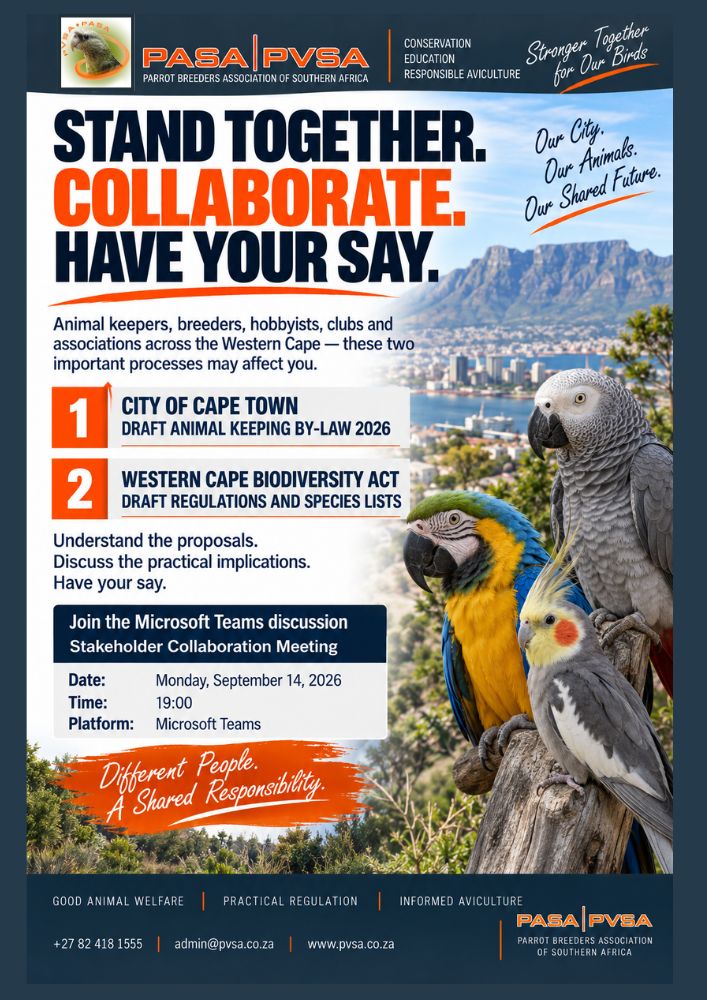
Animal keepers, breeders, hobbyists, clubs and associations in the Western Cape — this discussion may affect you
There are currently two separate regulatory processes that the broader animal-keeping and avicultural community needs to understand and discuss.
These processes are different and must not be confused with one another, but there is significant overlap in the people and organisations who may be affected.
For this reason, PASA will include both matters in the same stakeholder collaboration meeting.
Our objective is not to oppose regulation or conservation. It is to bring affected people together, understand the proposals, identify practical concerns and ensure that knowledgeable people from the different sectors participate constructively in the respective public processes.
1. CITY OF CAPE TOWN DRAFT ANIMAL KEEPING BY-LAW 2026
The first matter is the City of Cape Town Draft Animal Keeping By-law 2026.
This proposed By-law could affect a wide range of people and organisations, including bird keepers, aviculturists, pigeon fanciers, poultry keepers, rabbit keepers, beekeepers, dog and cat owners and breeders, livestock and equine keepers, exotic-animal keepers, pet shops, commercial breeders, hobby breeders, shows, clubs and other animal-related activities.
For aviculture specifically, the draft includes proposals concerning the keeping of more than five captive birds on residential premises, aviary standards, breeding and sales, shows, online advertising and other matters.
Public comment closes: 29 September 2026.
Read the Draft Animal Keeping By-law
PASA copy of the Draft By-law:
Download the City of Cape Town Draft Animal Keeping By-law 2026
2. WESTERN CAPE BIODIVERSITY ACT — DRAFT REGULATIONS AND SPECIES LISTS
A second and separate process is now beginning under the Western Cape Biodiversity Act 6 of 2021 (WCBA).
CapeNature, in collaboration with the Western Cape Department of Environmental Affairs and Development Planning (DEA&DP), has notified stakeholders of consultation on proposed Draft Western Cape Species Regulations and associated Draft Species Lists, Restricted Activities and Restricted Methods.
According to the stakeholder notification, these proposals will deal with authorisations and special management measures associated with species that are considered in need of protection or that may pose a threat to the environment.
The proposed lists cover a particularly broad range of species categories, including:
- species extinct in the wild;
- Critically Endangered species;
- Endangered species;
- Vulnerable species;
- other species requiring protection;
- species assessed by the IUCN as Near Threatened, Data Deficient or Not Evaluated;
- species included in CITES Appendices I, II and III;
- other indigenous species;
- extra-limital species;
- alien species;
- species requiring special management measures; and
- domesticated species.
The consultation will also consider restricted activities that may require authorisation or may be prohibited, as well as restricted methods relating to certain activities.
Why should animal keepers pay attention?
Because the scope described in the stakeholder notification is very broad.
It potentially reaches beyond traditional nature-conservation organisations and may be relevant to aviculturists, breeders, exotic-animal keepers, wildlife keepers, hobbyists, animal traders, businesses, clubs, associations and others working with species falling within the proposed lists.
For aviculture in particular, the inclusion of species appearing in CITES Appendices I, II and III, alien species and other categories makes it important for parrot and other bird breeders to examine the actual draft lists and regulations carefully once they are released.
We should not assume what the final effect will be before reading those documents.
That is exactly why participation is important.
Public review period
According to the stakeholder notification, the draft documents will be open for written comments, concerns and recommendations from:
11 September – 16 October 2026
The documents to be released for comment include:
Draft Western Cape Species Regulations
and
Draft List of Species in Need of Protection or Posing a Threat to the Environment, together with the proposed lists of Restricted Activities and Restricted Methods.
CapeNature stakeholder meetings
Stakeholders will also have an opportunity to attend public engagement meetings:
| Town | Venue | Date | Time |
|---|---|---|---|
| Oudtshoorn | Surval Boutique Olive Estate, R328 & Cango Caves Road | 15 September 2026 | 09:30–12:00 |
| Riversdale | De Doornkraal Vinotel, 8 Long Street | 16 September 2026 | 09:30–12:00 |
| Worcester | Cumberland Hotel, 2 Stockenstrom Street | 7 October 2026 | 09:30–12:00 |
| Velddrif | Riviera Hotel, 136 Voortrekker Road | 8 October 2026 | 09:30–12:00 |
According to the notification, no registration or RSVP is required, but each venue can accommodate a maximum of 100 attendees.
Stakeholders can also request registration as an Interested and Affected Party (I&AP) to receive further correspondence regarding the consultation.
Contact: Ms Amanda van Reenen / Ms Tamera Pillay
Email: cesppp@cesnet.co.za
Subject line: Cape Nature Section 49 of the WCBA
Why PASA wants to discuss both processes together
These are two different regulatory processes involving different authorities, and each will require its own comments and submissions.
However, many of the same people may be affected by both.
That gives us an opportunity to bring the wider community together.
We want bird associations, pigeon clubs, poultry organisations, beekeeping associations, animal breeders, exotic-animal keepers, pet organisations, businesses, veterinarians, welfare organisations, hobbyists and other affected stakeholders to participate.
This is not about PASA speaking on behalf of everybody.
It is about getting everybody around the same table.
We want to identify:
Who is affected? What sections or species affect them? What practical expertise do they have? What concerns need to be raised? What workable alternatives can be proposed? And who is willing to represent their particular sector in further engagement with the relevant government authorities?
Where we share the same concerns, we can work together.
Where specialist knowledge is required, the people who understand that particular field should lead that part of the discussion.
ONE MEETING. MANY SECTORS. A COMMON PURPOSE.
STAND TOGETHER. COLLABORATE. HAVE YOUR SAY.
Whether you belong to a large national association, a local club or no association at all, you are welcome.
Hobbyists are important.
Breeders are important.
Businesses are important.
Veterinarians and specialists are important.
Associations and clubs are important.
The people who work with and care for these animals every day have practical knowledge that should form part of these discussions.
We may keep different animals and belong to different organisations, but when legislation affects our communities, we need to communicate, collaborate and make informed representations.
JOIN THE STAKEHOLDER COLLABORATION MEETING
City of Cape Town Draft Animal Keeping By-law 2026
PLUS
Western Cape Biodiversity Act Draft Regulations & Species Lists
Date: Monday, 14 September 2026
Time: 19:00
Platform: Microsoft Teams
Microsoft Teams link:
https://teams.live.com/meet/9337445672193?p=JuVwCqEti3r9ipWs5N
We encourage associations to share this invitation with their committees and members.
We also encourage individual hobbyists and keepers to attend. You do not have to represent an association to participate.
Come prepared to identify which provisions affect you, what the practical implications may be and where you can contribute expertise.
Different animals. Different associations. Different interests.
TWO PROCESSES. ONE OPPORTUNITY TO WORK TOGETHER.
PASA | Parrot Breeders Association of Southern Africa
Related Articles posted: