
The City of Cape Town has published its Draft Animal Keeping By-law, 2026 for public comment.
PASA has reviewed the draft from an avicultural and responsible bird-keeping perspective, and several proposed provisions could have a direct impact on bird keepers, hobby breeders, commercial breeders, clubs, pet owners, businesses and other participants in aviculture.
The purpose of this article is not to create panic or to oppose animal welfare regulation.
It is to help aviculturists read the draft, understand the proposed changes and submit informed comments before the public-participation deadline.
Cape Town aviculturists: this affects us. Read it. Understand it. Come together. Submit informed comments before the deadline.
Why PASA is raising awareness
The draft by-law is intended to regulate the numbers and kinds of animals that may be kept, the conditions under which animals are kept, and measures relating to nuisance, health, disease, impoundment and enforcement.
PASA supports responsible animal welfare, good husbandry, hygiene, biosecurity and sensible regulation.
However, legislation affecting birds should also be:
practical, proportionate, scientifically informed and species appropriate.
A budgerigar is not a macaw.
A pair of finches is not equivalent to a pair of large parrots.
A hobby breeder is not automatically the same as a commercial animal business.
For this reason, PASA believes the avicultural community should carefully examine what is being proposed.
More than five birds could require a City permit
One of the most important provisions for aviculturists appears in section 27.
The draft states that on residential premises, a person may not keep or breed certain animals without applying to the City for a permit. This includes:
“more than 5 birds kept in captivity”
This means the provision is not limited to large-scale commercial breeders.
A hobbyist keeping only a few breeding pairs could potentially fall within the permit requirement.
For example, three breeding pairs already equal six birds.
PASA believes this is one of the provisions that requires careful scrutiny because a fixed numerical limit does not necessarily reflect the actual welfare, nuisance or public-health impact of different bird species.
Proposed aviary requirements
The draft also contains specific provisions relating to bird housing.
Section 34 states that birds must be kept in an aviary designed for that purpose, and an application for a permit to keep birds in an aviary must be accompanied by an approved building plan.
The draft further proposes that an aviary should not be situated within:
- 3 metres of a property boundary;
- 3 metres of a dwelling or structure used for human habitation or food preparation;
- 50 metres of certain water resources or water supplies intended for human consumption; and
- 6 metres of a boundary adjoining a road or public place.
These distances could be difficult or impossible to achieve on many ordinary residential properties.
This is one of the reasons PASA believes aviculturists should look carefully at the practical effect of the proposed wording.
Proposed construction standards
The draft also contains specific construction requirements.
It states that aviary walls must be constructed of brick, stone, concrete or another impervious material with a smooth internal surface, while floors must be concrete or another impervious material with a smooth finish.
Many responsible avicultural facilities use welded mesh, suspended aviaries, modular aviaries, indoor breeding rooms, species-specific housing systems and other recognised forms of bird accommodation.
The question that therefore needs to be considered is whether one set of construction standards can reasonably be applied across the wide variety of bird species and avicultural systems.
Breeding and selling birds
The draft also contains requirements dealing with the keeping, breeding and sale of animals for business purposes or gain.
It states that commercial animal breeders and businesses selling animals require City permits, with applications potentially including information on species, numbers, housing, enclosure dimensions, veterinary professionals and welfare plans.
This may be appropriate for certain genuinely commercial animal businesses.
However, PASA believes there should be a clear distinction between a commercial enterprise and a hobby breeder who occasionally sells surplus captive-bred birds.
That distinction is important for the avicultural community.
Online and social-media sales
The draft also provides that, without the relevant permit, a person may not sell or offer to sell an animal online or through social-media platforms.
This could affect the way bird breeders currently use:
Facebook groups, WhatsApp groups, websites, online classifieds and other digital platforms to advertise birds.
Again, the issue is not whether unlawful or irresponsible trading should be regulated.
The question is whether responsible hobby breeders and ordinary aviculturists should automatically fall into a commercial permitting system because they advertise captive-bred birds online.
Who could be affected?
The proposed by-law could potentially affect a wide range of people involved in bird keeping and aviculture, including:
pet bird owners, hobby breeders, parrot breeders, budgerigar breeders, canary and finch keepers, pigeon fanciers, commercial breeders, bird clubs, exhibitors, businesses, people advertising birds online, existing residential aviaries and people keeping captive-bred exotic bird species.
This is why PASA believes the discussion should not be limited to only large breeding establishments.
PASA’s position
PASA supports responsible animal welfare and sensible regulation.
We do not believe animal welfare and responsible aviculture are opposing objectives.
Both can and should be protected.
PASA’s concern is that rules affecting birds should be drafted with a proper understanding of:
bird biology, species differences, aviary design, breeding systems, biosecurity, practical husbandry and the realities of responsible aviculture.
Our position is therefore:
This is not about opposing animal welfare.
This is about ensuring that legislation affecting birds is practical, scientifically sound and written with an understanding of aviculture.
What PASA is asking aviculturists to do
PASA encourages all bird keepers, breeders, clubs, avian veterinarians, pet businesses and other interested parties to:
Read the draft by-law.
Consider how the proposed provisions would affect your own birds, property, aviaries or breeding activities.
Identify specific provisions that concern you.
Submit informed, factual and practical comments to the City.
The strongest public participation is not simply saying:
“We disagree.”
It is explaining:
what provision concerns you, how it would affect you, why it may be unreasonable or impractical, and what alternative you believe would achieve the City’s objective more effectively.
Public participation
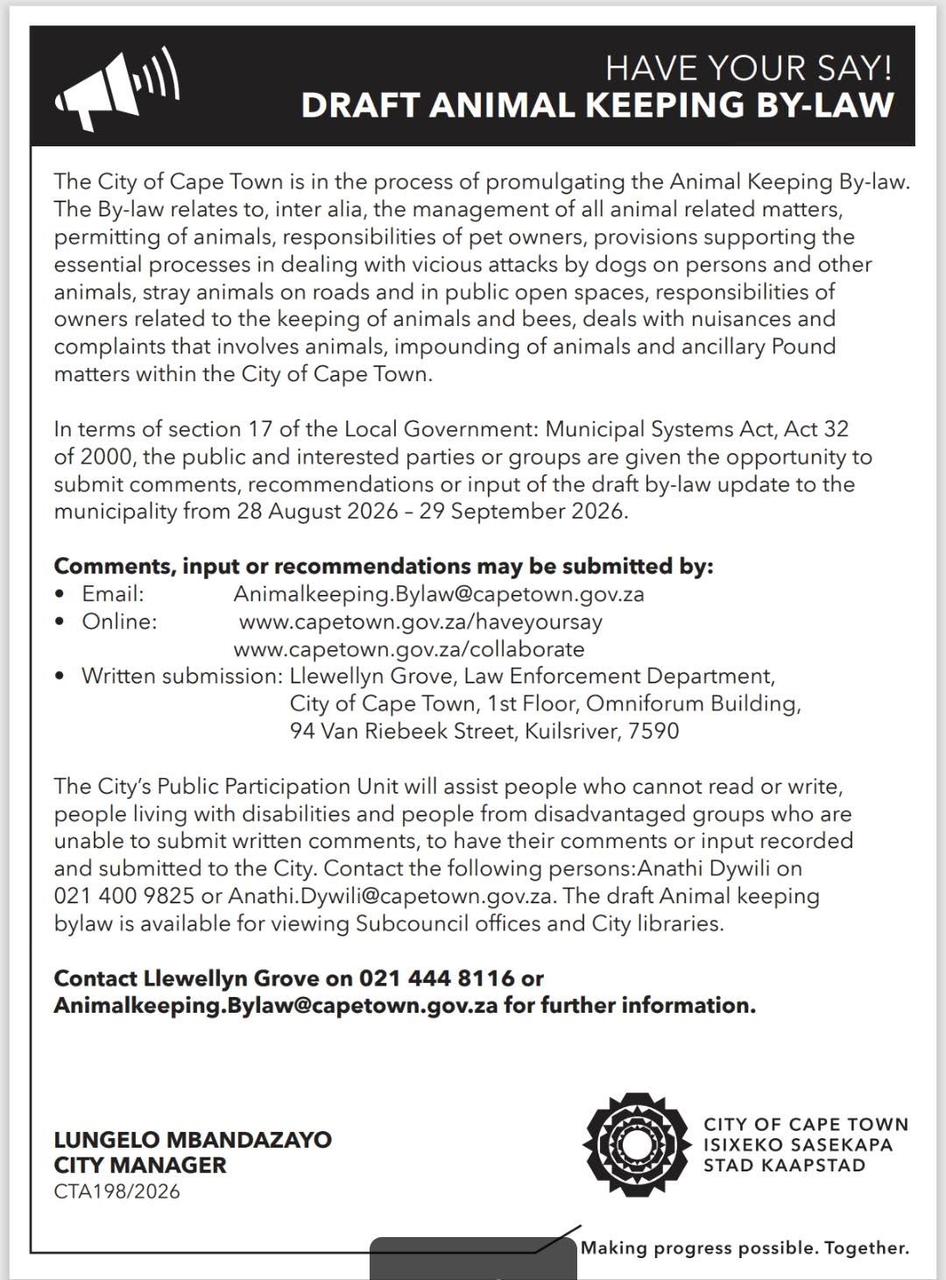
The City has invited comments and recommendations on the Draft Animal Keeping By-law.
The published public-participation notice states that comments may be submitted during the period:
28 August 2026 to 29 September 2026.
PASA encourages all affected aviculturists to participate before the deadline.
Read the documents
PASA recommends that members and interested bird keepers read the source documents themselves before submitting comments.
Document 1: City of Cape Town – Draft Animal Keeping By-law, 2026
Document 2: City of Cape Town – Public Participation Notice
PASA will continue to assess the proposed provisions and engage with the avicultural community on the issues affecting bird keeping.
Aviculture – Have Your Say
One industry. One discussion. One informed response.
Cape Town aviculturists: this affects us.
Read it. Understand it. Come together. Submit informed comments before the deadline.
PASA | Parrot Breeders Association of Southern Africa
Conservation • Education • Responsible Aviculture
PASA SUGGESTS: GET INFORMED. COME TOGETHER. HAVE YOUR SAY.
Why PASA is calling this forum
This forum is not intended to be a meeting where everyone simply complains about the Draft By-law.
The purpose is to bring together people with the same interests and practical experience in each section of the Draft Animal Keeping By-law, so that affected sectors can organise themselves, identify common concerns and develop practical alternatives
PASA therefore encourages affected parties to:
Join the stakeholder discussion on Monday evening, 14 September 2026, where interested parties can discuss the proposed by-law, identify practical concerns and consider constructive recommendations.
Magda Ross invited you to a Microsoft Teams Meeting:
City of Cape Town Draft animal keeping by law
Monday, September 14, 2026
7:00 PM – 11:30 PM (SAST)
Meeting link: https://teams.live.com/meet/9337445672193?p=JuVwCqEti3r9ipWs5N
Then, most importantly, make your voice part of the City’s official public-participation process.
You do not have to oppose the entire by-law. You can submit a comment, concern, recommendation, proposed amendment or supporting input on the provisions that affect you.
PUBLIC COMMENTS CLOSE 29 SEPTEMBER 2026
Email: Animal.bylaw@capetown.gov.za
Online: Submit your comment through the City of Cape Town’s official public-participation page
Attached is a Template, people can change it and use it as a background on how to participate privately in public comments.
Cape Town Template All Animals Email – Email: Animalkeeping.Bylaw@capetown.gov.za – CC the document to cctbylaw@pvsa.co.za
Cape Town Template All Animals online template – Online: www.capetown.gov.za/haveyoursay / www.capetown.gov.za/collaborate
Written submission: Llewellyn Grove, Law Enforcement Department, City of Cape Town, 1st Floor, Omniforum Building, 94 Van Riebeek Street, Kuilsriver, 7590