
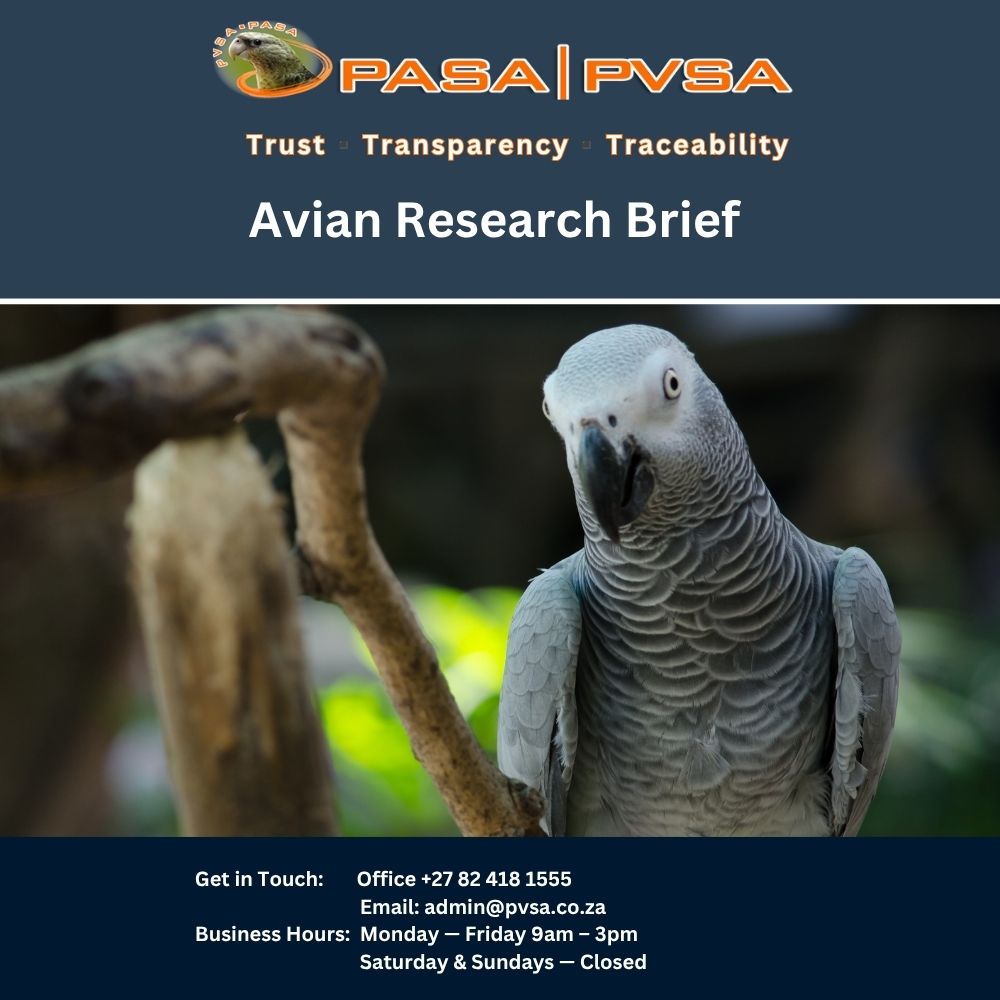
1. Healthy-looking parrots can carry parrot bornavirus
Scientific Reports — published 15 June 2026
Researchers tested 83 captive parrots from 13 species in India. PaBV-4 RNA was detected in 44 birds, including 5 of 26 apparently healthy birds housed with suspected PDD cases.
Practical takeaway: Do not rely on appearance when introducing or selling birds. New arrivals and exposed cage mates warrant strict separation and an avian-veterinarian testing plan. A positive result indicates infection, but does not by itself prove that the bird has clinical PDD.
Limitations: This was a regional, targeted population containing sick birds and exposed cage mates—not a prevalence survey of ordinary aviaries. Cloacal shedding can also be intermittent.
Evidence confidence: Moderate–high
Breeder-readiness: Ready to apply for quarantine planning; veterinary input needed for testing and interpretation.
2. Promising new PaBV antibody test—but not yet a stand-alone answer
The Veterinary Journal — June 2026
A newly developed ELISA achieved reported sensitivity of 92.9% and specificity of 96.7%. Among 208 captive psittacine samples in Thailand, 68.3% were antibody-positive.
Practical takeaway: Serology may become a useful addition to PCR when investigating exposed collections, particularly because PCR can miss intermittently shedding birds. Breeders should ask laboratories which validated PaBV tests they use and whether repeat PCR plus serology is appropriate.
Limitations: Antibodies show exposure or infection—not necessarily PDD. Field performance outside Thailand and across more species still needs confirmation. This specific assay may not yet be routinely available.
Evidence confidence: Moderate–high for assay development; moderate for wider field use
Breeder-readiness: Veterinary/research use only at present.
3. Anti-ganglioside antibodies did not diagnose PDD reliably
Animals — published 10 May 2026
Researchers examined 257 plasma samples from experimentally PaBV-infected cockatiels. Anti-ganglioside antibody results did not correlate with clinical avian ganglioneuritis or confirmed lesions.
Practical takeaway: Do not use an anti-ganglioside antibody result alone to declare a bird PDD-positive or PDD-free. Diagnosis still requires the combined assessment of history, clinical signs, imaging, appropriate PaBV testing and, where applicable, pathology.
Limitations: The work involved experimentally infected cockatiels; naturally infected birds and other parrot species may present differently.
Evidence confidence: High for the test’s poor diagnostic value in this study
Breeder-readiness: Ready to apply—avoid relying on this test alone.
4. Faster testing for avian polyomavirus is technically possible
Poultry Science — available online in 2026
A new isothermal RPA assay detected avian polyomavirus in about 25 minutes at 41°C. Testing of samples from 63 suspected parrot deaths agreed completely with the study’s qPCR classification.
Practical takeaway: This could eventually enable faster outbreak screening where full PCR infrastructure is limited. It reinforces the value of promptly submitting tissues from unexplained nestling deaths instead of treating recurring chick losses as a breeding problem.
Limitations: It remains a laboratory assay, the clinical sample set was small, and wider validation is required. It is not a breeder-operated aviary test.
Evidence confidence: Moderate
Breeder-readiness: Promising but preliminary; veterinary or diagnostic-laboratory use only.
Bottom line
The strongest practical message this week concerns silent PaBV infection: apparently healthy birds cannot be treated as low-risk simply because they look well. Quarantine, separation of equipment and airspace where practical, daily care of resident birds before quarantined birds, and veterinarian-guided testing remain more dependable than visual screening or any single test result.